
Spray foam · Williston, ND
Crawl Space and Rim Joist Spray Foam
Crawl space and rim joist spray foam fixes the complaint we hear most from homeowners in Williston: the floors are cold, the baseboards are drafty, and the furnace runs all night. The cause is almost always the same. The rim joist, the band of framing where the floor sits on the foundation, is leaking outside air straight into the floor system, and the crawl space below is either vented to the outdoors or insulated with batts that stopped working years ago.
Williston Insulation treats the rim joist and the crawl space as one assembly, because they are. Closed-cell foam on the rim seals the leak. Closed-cell on the crawl walls and a vapor barrier on the ground turn a damp, cold hole into a conditioned space. The floors warm up, the drafts stop, and the furnace gets a break. Drew does the crawling himself.
Right for
Any house with a basement or crawl space and cold floors, drafty baseboards, or frost on the rim in winter.
Not the answer for
A crawl space with standing water or a failing foundation, which needs drainage or structural work before insulation will hold up.
The rim joist: the leak every older house has
Walk a Williston basement built before the 2010s and look at the top of the foundation wall. The rim joist sits there, a single board of framing with the sill plate under it and the subfloor over it. Most of the time there is a scrap of fiberglass pushed into each bay, often dark with the dust that outside air has been pulling through it for decades.
That dust is the evidence. Fiberglass does not stop air. Every joint between sill and concrete, every gap where the rim meets the joists, and every hole for a hose bib, dryer vent, or electrical service is a path for wind to come straight into the floor system. In a northwest wind at twenty below, that air runs the length of the joist bays and comes out at your baseboards.
Two inches of closed-cell foam across the rim, the sill, and the top of the foundation wall seals all of it in one pass. The foam bonds to wood and concrete, fills the irregular gaps fiberglass cannot, and becomes a vapor retarder at that thickness so the rim does not frost from the inside. It is the highest-return foam job in an existing house, and it is often the only foam a house needs.
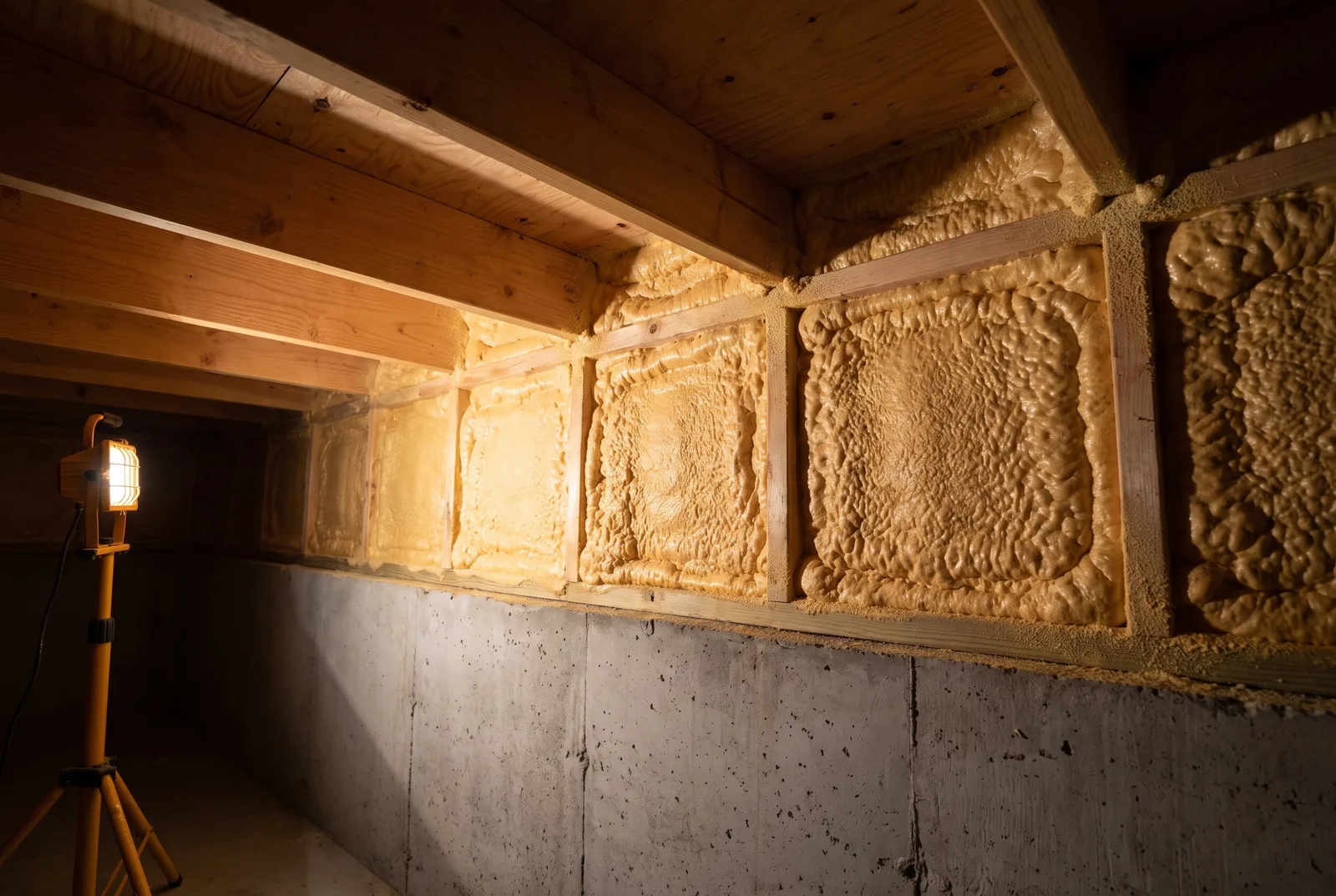
Crawl space encapsulation
A vented crawl space was the standard for decades. Vents in the foundation let outside air through, and batts were hung between the floor joists above. In Climate Zone 7 that approach fails twice. In winter the vents let in air at outdoor temperature, so the floor above is cold no matter how thick the batts are, and pipes in the crawl freeze. In summer humid air comes through the vents, hits the cool ground and framing, and condenses.
Encapsulation reverses the design. We close the vents, spray closed-cell foam on the foundation walls and the rim joist, and lay a heavy polyethylene vapor barrier over the ground, lapped and taped at the seams and run up the wall. The crawl space becomes part of the conditioned house. The floor above stays close to room temperature, the plumbing stays above freezing, and the space dries out.
Foam thickness on the crawl walls is usually two to three inches of closed-cell, which meets or exceeds the R-10 the code expects at the crawl wall and gives you the vapor retarder in the same layer. Old batts between the joists come out before we spray, because they are usually damp and they hide the rim.
The vapor barrier on the ground
The dirt floor of a crawl space is a moisture source year-round. Even dry-looking ground releases water vapor into the air above it, and that vapor is what rusts ductwork, grows mold on joists, and makes a crawl smell the way it does.
The ground vapor barrier is what makes encapsulation work. We use a heavy polyethylene sheet, lapped at the seams, taped, and run up the foundation wall where the foam locks the edge in place. Piers and posts get wrapped. The barrier is not a finish floor, but it is tough enough to crawl on for service work.
Once the ground is covered and the walls are foamed, the crawl needs a small amount of conditioned air or a dehumidifier to stay dry. In most Williston houses a supply register or a simple transfer opening to the basement does the job. We set that up as part of the encapsulation.
When the crawl space is not ready for foam
Foam goes on after the water problems are solved, not before. If the crawl has standing water in spring, a sump and drainage come first. If the foundation wall is bowed or crumbling, a contractor needs to look at it before we cover it. If there is active mold on the joists, it gets cleaned before the space is sealed.
We check all of this on the site visit. Most Williston crawl spaces are dry enough to encapsulate as they are, but when one is not, we say so and point you at the right fix first. Spraying foam over a wet wall wastes your money and hides a problem that will get worse.
What you get
- Warmer floors, because the air under them is no longer outdoor air
- Stops the baseboard drafts that come from the rim joist
- Keeps crawl space plumbing above freezing through January
- Dries out the crawl, which cuts odor and protects the framing
- Closed-cell is a vapor retarder and does not absorb water, so it holds up in a damp space
- Often the single highest-return insulation job in an existing house
How the job runs
- 1
Inspect the crawl and the rim
We look at moisture, drainage, existing batts, vents, plumbing, and the rim joist from inside, and tell you whether the space is ready for foam.
- 2
Remove old batts and debris
Damp fiberglass between the joists and on the rim comes out and is bagged. The ground is cleared of construction scrap so the vapor barrier lies flat.
- 3
Spray the rim and walls
Closed-cell goes on the rim joist, sill, and foundation walls in lifts to the quoted thickness. Penetrations and vents are sealed.
- 4
Lay the vapor barrier and condition the space
Poly is lapped, taped, and run up the wall. We add a supply or transfer opening so the crawl stays dry, then walk it with you.
What drives the cost of crawl space and rim joist foam
A rim joist alone is a small job. Full encapsulation is a larger one. The factors below set where your project lands. Send a quote request with the foundation type, the approximate footprint, and a couple of photos of the crawl or rim if you can get them, and we will come out and measure.
- Linear feet of rim joist and square footage of crawl wall
- Foam thickness, usually two to three inches of closed-cell
- Crawl space height and access, which sets how long the work takes
- Removal of old batts and debris
- Ground vapor barrier area and the number of piers and penetrations to seal
- Whether ductwork, wiring, or plumbing crowds the rim
- Any drainage or cleanup that has to happen before foam goes on
Common questions
Why are my floors cold even though there is insulation under them?
Because batts between floor joists do not stop air. If the crawl space is vented or the rim joist leaks, outdoor air moves through the floor system and the batts just filter it. Sealing the rim with closed-cell foam and encapsulating the crawl fixes the cause instead of adding more fiberglass to the symptom.
How thick should spray foam be on a rim joist?
Two inches of closed-cell is the standard target. At that thickness the foam acts as a vapor retarder, so the rim does not frost from the inside, and it delivers roughly R-12 to R-14. Some homeowners go to three inches for more R-value. Either way the air seal is what matters most.
Should I close my crawl space vents?
Yes, if the crawl is being encapsulated. Vents let outdoor air in all winter and humid air in all summer, which is the opposite of what the space needs. Once the walls are foamed and the ground is covered, we seal the vents and give the crawl a small amount of conditioned air so it stays dry.
Can you foam a crawl space with a dirt floor?
Yes. Most crawl spaces around Williston have dirt floors. We clear the debris, spray the walls and rim, and then lay a heavy polyethylene vapor barrier over the ground, lapped and taped. The barrier stops ground moisture and is tough enough to crawl on for service work later.
Is rim joist foam worth it if I am not doing the whole crawl space?
Yes. The rim joist is the biggest single air leak in most older houses, and sealing it with closed-cell foam is a half-day job with a large effect on drafts and heating load. Many basement houses in Williston only need the rim done, and we will tell you if that is your situation.
Where we do this work
We run crawl spaces & rim joists jobs out of our shop on the west side of Williston, and across the region: Williston, ND, Ray, ND, Fairview, MT and everything within about an hour of the shop.
Related services
Get a quote on crawl spaces & rim joists
Send the basics and an owner comes back with a straight answer on what it needs, what it doesn't, and what it costs.