
Flagship service · Williston, ND
Spray Foam Insulation in Williston, ND
Spray foam insulation in Williston, ND has to do two jobs at once: stop the wind and hold the heat. Williams County sits in IECC Climate Zone 7, the coldest zone in the lower 48, and a January northwest wind finds every gap in a rim joist or a steel wall. Spray foam is the one insulation that seals those gaps and insulates them in the same pass. That is why we use it, and it is also why we do not use it everywhere.
Williston Insulation is owner-operated. Drew Niskanen quotes the job, sprays it, and trims it. We install both closed-cell and open-cell foam, and we will tell you plainly which one an assembly needs, or whether a cheaper material would do the same work. Our shop is at 1926 44th St W in Williston, and we cover roughly an hour's drive in every direction.
Right for
Rim joists, crawl spaces, steel and post-frame buildings, cathedral ceilings, and any assembly that needs air sealing and insulation in one pass.
Not the answer for
Simple vented attics with good access, walls that already have decent batts, and budget jobs where foam on one surface won't change how the house feels.
Closed-cell spray foam: the workhorse for Climate Zone 7
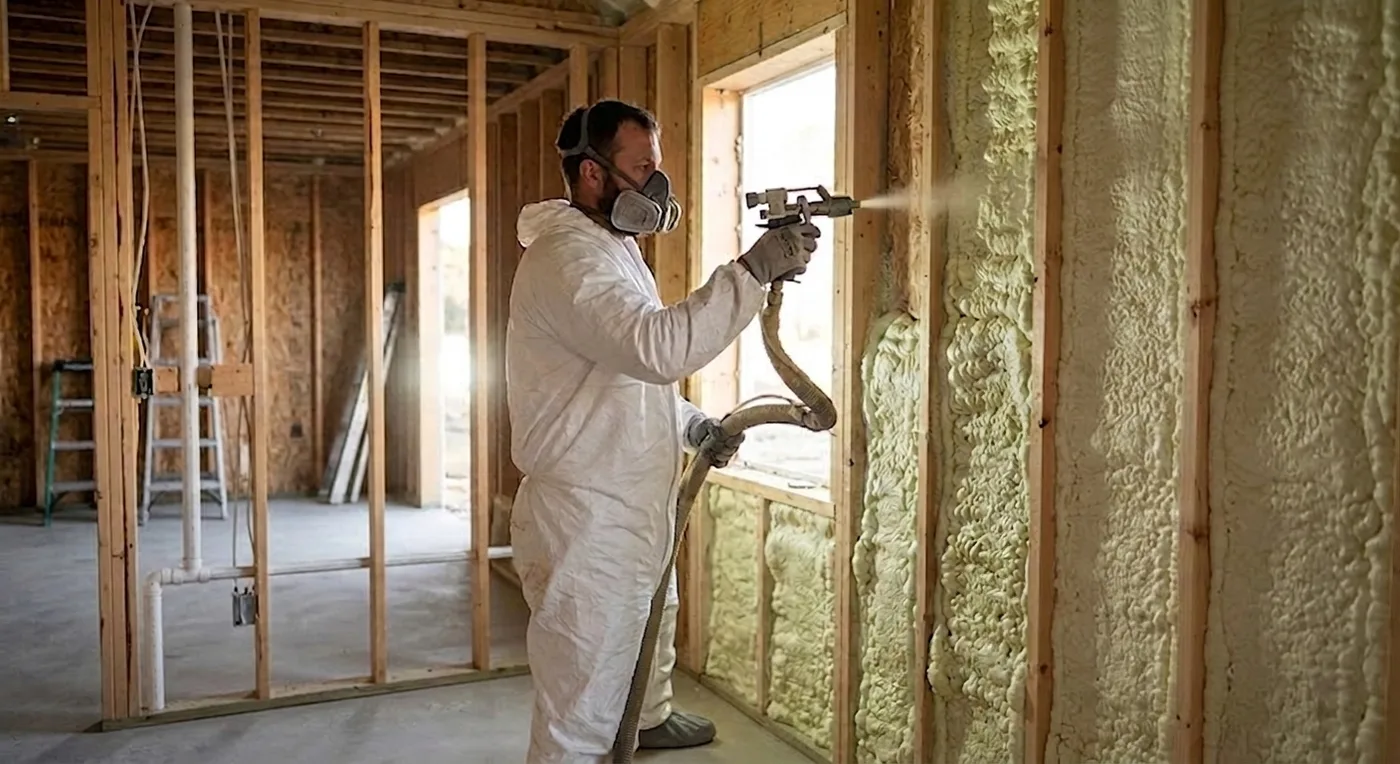
Closed-cell foam is a dense, rigid two-part polyurethane that expands to roughly 30 times its liquid volume and cures hard. It runs about R-6 to R-7 per inch, so two inches on a rim joist delivers roughly R-12 to R-14 and three inches on a steel wall approaches R-20. It bonds to wood, concrete, and steel, and it adds stiffness to whatever it touches.
The property that matters most here is vapor behavior. At around two inches, closed-cell foam becomes a vapor retarder. In a Zone 7 winter, warm indoor air carries moisture outward through the wall toward the cold side. If that moisture reaches a surface that is below the dew point, it condenses. Closed-cell foam stops the air movement and slows the vapor before it gets there. That is why it is the right answer against concrete, against steel, and in any assembly that cannot be vented.
Closed-cell also does not absorb water. A crawl space wall that gets damp in spring, a rim joist that sees a little ice dam backup, or a shop floor edge that gets splashed will not hold moisture in the foam. For most of the work we do around Williston, closed-cell is the default.
Open-cell spray foam: where it fits and where it does not
Open-cell foam is a softer, lower-density foam that expands much more than closed-cell and cures spongy. It runs roughly R-3.5 to R-3.8 per inch, so it takes nearly twice the thickness to match closed-cell for R-value. It is an excellent air barrier and it is quieter to live with because it absorbs sound.
Open-cell is not a vapor retarder at any practical thickness. Moisture vapor passes through it. In a mild climate that is a feature, because the assembly can dry in both directions. In Climate Zone 7 it is a risk unless the assembly is designed for it. Open-cell sprayed directly against cold roof sheathing in a Williston winter can let vapor reach that sheathing and condense. If we use open-cell in a roof deck, it is paired with a separate interior vapor retarder or a layer of closed-cell on the cold side.
Where open-cell makes sense here: interior partition walls for sound, deep wall cavities in a conditioned space where a vapor retarder will be installed separately, and budget-driven attic floor work where the goal is air sealing and the thickness is available. We quote it when it fits. We do not push it because it is cheaper per inch.
Where spray foam earns its cost
Foam costs more per R than batts or blown-in. It pays for itself in the assemblies where nothing else works well.
Rim joists are first on the list. The band of framing where the floor system sits on the foundation is the leakiest part of almost every house in Williston built before the 2010s. Fiberglass stuffed in there does nothing against air movement. Two inches of closed-cell seals it and insulates it in one pass.
Crawl spaces come next. A vented crawl with batts hanging from the floor joists gives you cold floors and damp insulation. Closed-cell on the foundation walls and rim, with a ground vapor barrier, turns it into a conditioned space.
Metal buildings and shops have steel skin on steel purlins. Fiberglass blanket against steel gets wet from condensation and sags. Closed-cell sprayed direct to the metal stops the condensation because the steel never sees interior air.
Cathedral ceilings and unvented roof decks have no room for R-60 of loose fill and no way to vent properly. Closed-cell against the underside of the sheathing makes the assembly work.
Heated shops and garages with a concrete stem wall and a wood or steel wall above are a hybrid. Foam at the stem wall, the sill, and the rim, then batts or blanket above, is often the right mix.
- Rim joists and sill plates on any house with a basement or crawl
- Crawl space walls and encapsulation
- Steel shops, pole barns, and oilfield service buildings
- Cathedral ceilings and unvented roof assemblies
- Bonus rooms over garages and knee walls
- Heated garages and shop additions
What a spray foam job looks like
Prep comes first and takes longer than most people expect. We clear the work area, remove any old fiberglass that would trap moisture behind the foam, and vacuum out debris. Electrical boxes, windows, floor drains, and anything that must stay clean gets masked with plastic and tape. In a house, we isolate the work area from the living space.
Spray passes are done in lifts. Closed-cell is applied in layers of roughly one to two inches and allowed to set between passes. Spraying too thick in one lift traps heat from the reaction and can shrink or crack. We build to the specified thickness and check it with a depth gauge, not by eye.
Cure and ventilation matter. The foam is tack-free within minutes, but it continues to off-gas as it cures. We run ventilation during the spray and for a period after, and we ask the homeowner to stay out of the sprayed area during that window. We will give you the re-entry timing for the product we used.
Trimming is the last step. Any foam that expanded past the face of the framing gets cut flush so drywall or sheathing can go on. On a rim joist or a shop wall that stays exposed, we leave the surface as sprayed unless a thermal barrier or ignition barrier is required by code, in which case we talk through the coating or covering options before we start.
Spray foam and the Zone 7 code
Williams County builds under IECC Climate Zone 7. The 2021 IECC residential minimums call for R-60 in the ceiling, R-20 cavity plus R-5 continuous in above-grade walls, R-15 on basement walls, and R-10 at the crawl space wall or slab edge.
Spray foam meets these numbers differently than batts. Closed-cell in a 2x6 wall at three inches delivers roughly R-18 to R-21 in the cavity with the rest of the bay left for wiring or filled with batt (the flash-and-batt approach). The continuous R-5 still has to come from foam board or another layer outside the framing, because foam in the cavity is interrupted by every stud.
Rim joists and basement walls are where foam most directly satisfies the code. Two to three inches of closed-cell on a basement wall hits R-15 and acts as the vapor retarder in one material. Code also requires a thermal barrier (typically half-inch drywall) between foam and living space, or an approved ignition barrier in crawl spaces and attics. We build those requirements into the quote so there is no surprise at inspection.
On new construction, we coordinate with the builder and the inspector on blower door targets, which foam makes much easier to hit. MDU serves gas and electric in Williston; ask about current utility rebate programs when you plan a project.
What you get
- Air barrier and insulation in one material, which matters more in Zone 7 wind than anywhere else
- Closed-cell is a vapor retarder at around two inches, so it works against concrete and steel
- Fills irregular cavities, rim joists, and around penetrations where batts leave gaps
- Does not sag, settle, or hold water the way fiberglass against steel does
- Adds rigidity to steel walls and roof decks
- Owner sprays every job, so the person who quoted it is the one holding the gun
How the job runs
- 1
Site visit and assembly review
Drew walks the building, checks existing insulation, moisture, venting, and access, and tells you which surfaces need foam and which do not.
- 2
Written scope and thickness
You get a quote that names the product, the thickness in inches, the surfaces covered, and any prep or removal included.
- 3
Prep, mask, spray in lifts
We clear and mask, then spray closed-cell in one to two inch lifts and check depth with a gauge. Ventilation runs during the spray and cure.
- 4
Trim, inspect, and clean up
Foam is trimmed flush where it will be covered, thickness is verified, and the area is cleaned. We walk it with you before we leave.
What drives the cost of spray foam
We quote foam by the assembly, not by a flat rate, because the same square footage can be an easy job or a hard one. The factors that move the number are listed below. Send a quote request with the building type, the surfaces you want sprayed, and a few photos, and we will come out and measure.
- Square footage of surface to be sprayed
- Thickness in inches, which sets how much material goes on the wall
- Closed-cell versus open-cell (closed-cell costs more per inch but needs fewer inches)
- Access: a rim joist you can stand at versus one behind ductwork, or a roof deck that needs a lift
- Whether old insulation has to be removed and hauled first
- Whether the building is heated, which affects cure conditions in winter
- Thermal or ignition barrier coatings where code requires them
When we'd talk you out of it
We sell the assembly the building needs. These are the jobs where foam is the wrong answer.
- A simple vented attic with good access. Blown-in to R-60 does that job for a fraction of the cost of foam, and it does it well.
- A wall that already has decent batts and only needs air sealing. Sealing the top plates, penetrations, and rim joist gets most of the benefit without tearing into drywall.
- A tight budget where foam would go on one surface and nothing else gets touched. One foamed wall in a leaky house will not change how the house feels. We would rather spend that money on the rim joist and attic air sealing.
Where we spray it
Pole Barns & Shops
Closed-cell foam sprayed direct to the steel skin of post-frame barns and shops, stopping the condensation drip and making the building cheap to heat.
Crawl Spaces & Rim Joists
Closed-cell foam on the rim joist and crawl space walls, with a ground vapor barrier, to fix the cold floors and drafts almost every older Williston house has.
New Construction
Foam scheduled into the build: rim joists, roof decks, and flash-and-batt walls sprayed after mechanicals and before drywall, ready for the insulation inspection.
Metal Buildings
Closed-cell foam for steel-framed shops, oilfield service buildings, and commercial metal structures, including removal of failed fiberglass blanket.
Builders: see how a new-construction job runs with one insulation sub.
Common questions
Is closed-cell or open-cell spray foam better for Williston?
Closed-cell, for nearly every assembly here. It carries roughly twice the R-value per inch, it acts as a vapor retarder at around two inches, and it does not absorb water. Open-cell has a place in interior walls and some conditioned-space cavities, but in Climate Zone 7 it needs a separate vapor retarder to be safe against cold sheathing.
How thick should spray foam be in a Williston house?
It depends on the surface. Two inches of closed-cell on a rim joist is a common target. Basement walls usually get two to three inches to meet R-15. Roof decks and cathedral ceilings need more, often five to seven inches of closed-cell or a hybrid with batts, to approach the R-values the code expects for a ceiling.
Does spray foam need to be covered?
Usually, yes. Code requires a thermal barrier, typically half-inch drywall, between foam and a living space. In crawl spaces, attics, and some shops, an approved ignition barrier coating or covering is allowed instead. We tell you what applies to your building and include it in the quote so inspection is not a surprise.
Can spray foam go over old fiberglass?
No. Old batts or blanket have to come out first. Foam needs a clean, dry surface to bond, and fiberglass left behind traps moisture between the foam and the wall. We include removal and cleanout in the quote when it applies, and we haul the old material away.
How long do we have to stay out of the house?
Plan on staying out of the sprayed area during the work and for a period after, with ventilation running the whole time. The exact window depends on the product and the amount sprayed. We give you the re-entry timing for your job before we start so you can plan around it.
Where we do this work
We run spray foam jobs out of our shop on the west side of Williston, and across the region: Williston, ND, Watford City, ND, Crosby, ND and everything within about an hour of the shop.
Related services
Get a quote on spray foam
Send the basics and an owner comes back with a straight answer on what it needs, what it doesn't, and what it costs.