
Spray foam · Williston, ND
Metal Building Insulation in Williston, ND
Metal building insulation in Williston has to handle two things steel does badly: conducting heat and sweating. A pre-engineered steel building has steel panels on steel girts and purlins, bolted to a steel frame, and every one of those members runs straight from the outside air to the inside. Add a heater, a wash bay, or a few trucks coming in with snow on them, and the roof steel drips. Williston Insulation sprays closed-cell foam direct to the steel to stop both problems at once, and we take down the old fiberglass blanket that is usually hanging there first.
We work on shops, oilfield service and maintenance buildings, equipment storage, and light commercial steel structures in Williston, Watford City, Tioga, Stanley, and along the highways between them. Drew quotes the job and sprays it.
Right for
Pre-engineered steel buildings, oilfield shops and wash bays, and commercial metal structures that need to stay dry and heatable.
Not the answer for
Cold storage with no heat and no moisture load, where a vented shell and a drip-stop membrane do enough.
Thermal bridging through girts and purlins
Steel conducts heat far better than wood. In a pre-engineered building, the wall girts and roof purlins are steel, and they touch the exterior panels on one side and the interior on the other. Every girt is a thermal bridge: a path for heat to leave the building and for cold to come in, no matter how much insulation is hung between them.
You can see it on a frosty morning. The outside of the panels shows a stripe of melted frost along every girt and purlin line, because heat is leaking through the steel. Inside, those same lines are the first place frost forms.
Closed-cell foam sprayed across the panels and over the girts and purlins breaks the bridge. The foam covers the steel continuously, so there is no bare member touching interior air. Two to three inches across the whole surface, with the foam wrapping each girt, is the standard approach. In a heated building this changes the heating load more than the R-value number alone would suggest, because the bridges were carrying a large share of the loss.
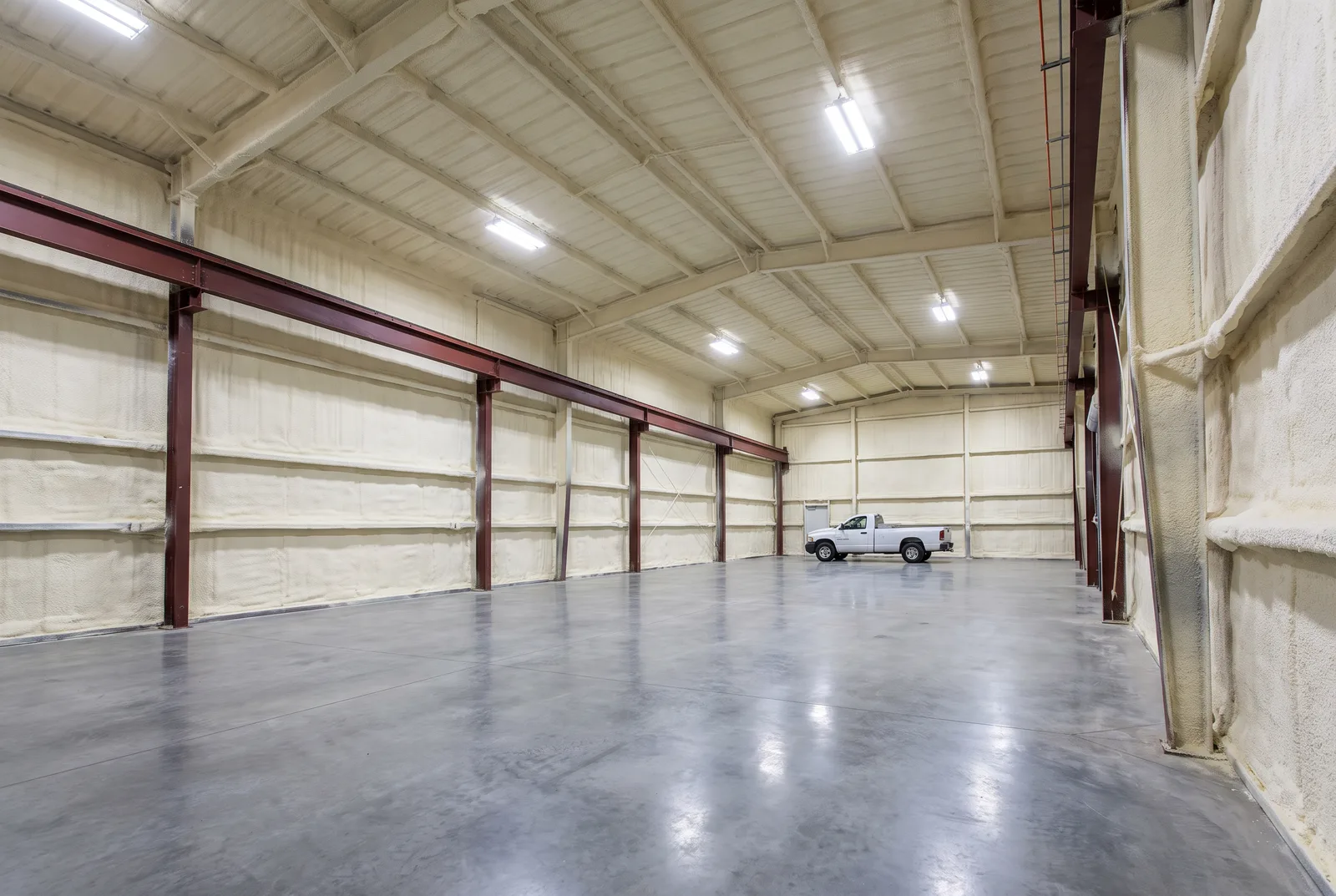
Replacing failed fiberglass blanket
Most steel buildings in the Williston area were delivered with vinyl-faced fiberglass blanket draped over the purlins and girts before the panels were screwed on. It is a cheap install and it fails in a predictable way. Air reaches the steel through every fastener and lap, condensation forms on the cold panel, and the blanket soaks it up. Over a few winters the blanket gets heavy, sags between purlins, and tears at the facing. The R-value drops, the vinyl facing gets stained, and the building drips anyway.
We remove the blanket before spraying. That means cutting it down, bagging it, and hauling it, and it exposes the panel so the foam can bond. Foam over blanket is not an option: it traps moisture against the steel and has nothing solid to stick to.
Once the blanket is out, closed-cell goes direct to the panel. The finished surface is rigid, does not absorb water, and does not sag. In a wash bay or a shop that gets pressure-washed, that matters more than the R-value.
Oilfield service buildings and wash bays
Oilfield shops around Williston see heavy use: trucks idling inside, steam from washdown, doors open in wind, and big temperature swings when the overhead doors cycle. The moisture load is high and the building has to dry fast.
Closed-cell foam is the right material because it is a vapor retarder at two inches, it does not take on water, and it tolerates washdown. On the roof and upper walls, two to three inches direct to the steel. On lower walls in a wash bay, foam is covered with liner panel or an approved coating so it is protected from spray and impact.
We also pay attention to the overhead door openings. The door frames, headers, and the wall on either side are where a big building leaks most, and foam at those edges keeps the heated air in when the doors are closed. Exposed foam in a shop usually needs an ignition barrier coating; we include it when it applies.
Commercial metal structures and code
On a commercial steel building, the insulation is usually specified by the building designer, and we install to that spec. Where no spec exists, we size the foam to the Climate Zone 7 commercial requirements for the assembly and write it into the quote so the inspector can verify it. Thermal barriers between foam and occupied space, and ignition barriers in unoccupied areas, are part of the scope.
For buildings with a suspended ceiling and a cold attic above, we sometimes insulate the ceiling instead of the roof deck, which opens the door to blown-in and keeps the roof vented. The decision depends on where the mechanicals run and whether the attic is used. We talk it through on the site visit. MDU serves the Williston area; ask about current utility rebate programs for commercial work when you plan the project.
What you get
- Breaks the thermal bridge through every girt and purlin
- Stops roof and wall condensation in heated shops and wash bays
- Replaces sagging, wet fiberglass blanket with a rigid surface that does not absorb water
- Seals fastener holes, panel laps, and the base of the wall in one pass
- Tolerates washdown and high moisture loads in oilfield buildings
- Scoped to the designer's spec or the Zone 7 commercial requirement, with barriers included
How the job runs
- 1
Inspect the shell and existing insulation
We check the panels, girts, purlins, door openings, moisture, and the condition of any blanket, and confirm whether the building is heated and how it is used.
- 2
Scope with removal and barriers
The quote covers blanket removal and haul-off, foam thickness on roof and walls, and any liner panel or coating required where foam stays exposed.
- 3
Remove blanket, mask, spray
Old blanket comes down and is bagged. Floors, equipment, lights, and doors are masked. Closed-cell goes on in lifts direct to the steel, wrapping the girts.
- 4
Coat or cover, trim, clean up
Ignition barrier coatings or liner panel go on where specified. Overspray is trimmed, the building is swept, and we walk it with you.
What drives the cost of metal building insulation
Steel buildings range from a small shop to a large service building with wash bays, so the quote follows the building and its use. The factors below set the number. Send a quote request with the building dimensions, eave height, whether it is heated, and photos of the existing insulation, and we will come out and measure.
- Roof and wall square footage
- Foam thickness on each surface
- Removal and haul-off of existing fiberglass blanket
- Eave and ridge height, which decides whether a lift is needed
- Whether the building is heated during the spray
- Liner panel or ignition barrier coating where foam stays exposed or takes abuse
- Number and size of overhead doors and other openings to detail
Common questions
Can you spray foam over existing fiberglass blanket in a metal building?
No. The blanket has to come down first. Foam needs a clean, dry panel to bond to, and blanket left in place traps condensation against the steel. We cut the blanket down, bag it, and haul it as part of the job, then spray closed-cell direct to the exposed panels and girts.
How thick should spray foam be on a steel building?
Two inches of closed-cell is the minimum on the roof, because that thickness is a vapor retarder and stops condensation. Heated shops and oilfield buildings typically get two to three inches on walls and roof, covering the girts and purlins so the thermal bridges are broken. Thicker lifts are available where more R-value is wanted.
Why does my steel building still drip with insulation in it?
Because fiberglass blanket does not stop air from reaching the cold panel. Moisture in the building air condenses on the steel behind the blanket, soaks into it, and drips through. Closed-cell foam sprayed direct to the panel keeps the interior air off the steel, so there is no cold surface for condensation.
Does foam in a shop need to be covered?
Often, yes. Exposed foam in an occupied shop usually requires an approved ignition barrier coating, and foam in a wash bay or at equipment height needs physical protection such as liner panel. We tell you what applies to your building and its use, and we include it in the scope.
Will foam work in an oilfield wash bay?
Yes, with closed-cell and protection on the lower walls. Closed-cell does not absorb water and acts as a vapor retarder, so it holds up to steam and high humidity. The lower walls get liner panel or a coating so pressure washing and impacts do not damage the foam. The roof and upper walls stay exposed or coated.
Where we do this work
We run metal buildings jobs out of our shop on the west side of Williston, and across the region: Williston, ND, Crosby, ND, Watford City, ND and everything within about an hour of the shop.
Related services
Get a quote on metal buildings
Send the basics and an owner comes back with a straight answer on what it needs, what it doesn't, and what it costs.