
Spray foam · Williston, ND
Spray Foam Insulation for Pole Barns and Shops
Pole barn spray foam insulation is the most common request we get at Williston Insulation, and it is usually prompted by one thing: water dripping off the roof steel in February. A post-frame shop outside Williston has steel roofing screwed to wood purlins, steel siding on wood girts, and nothing between the inside air and the metal. When that steel sits at outdoor temperature and a heater or a running truck puts moisture in the air, the underside of the roof sweats. The drip rusts tools, stains the floor, and rots the purlins over time.
Closed-cell spray foam applied directly to the steel ends that problem. It also turns a building that was never meant to be heated into one you can keep at 50 degrees all winter without feeding the furnace around the clock. We spray post-frame buildings in Williston, Watford City, Tioga, Ray, Stanley, and across the river in Sidney and Fairview.
Right for
Post-frame shops, pole barns, and ag buildings with steel roofing and siding, heated or about to be.
Not the answer for
Unheated hay or equipment storage where a drip edge and good ventilation solve the condensation problem for less.
Why steel roofing sweats and how foam stops it
Condensation happens when warm, moist air touches a surface colder than its dew point. In a Williston shop in winter, the roof steel is at outdoor temperature, and outdoor temperature is often well below zero. The air inside carries moisture from a heater, from snow melting off a pickup, from a concrete floor, or from livestock. The moment that air touches the steel, the moisture condenses, freezes into frost on the purlins, and then drips when the sun hits the roof or the heat comes on.
Fiberglass blanket with a vinyl facer, the standard builder install, slows this down but does not stop it. Air still reaches the steel through seams and fastener holes, and the blanket soaks up the condensate.
Closed-cell foam sprayed direct to the steel solves it because the interior air never touches the metal. The foam bonds to the panel and the purlins, seals every fastener and lap, and its surface stays close to room temperature. No cold surface, no condensation. Two inches is usually the minimum we spray on a roof, both for R-value and because that thickness makes the foam a vapor retarder.
Heated versus unheated pole barns
The plan changes depending on what the building is for.
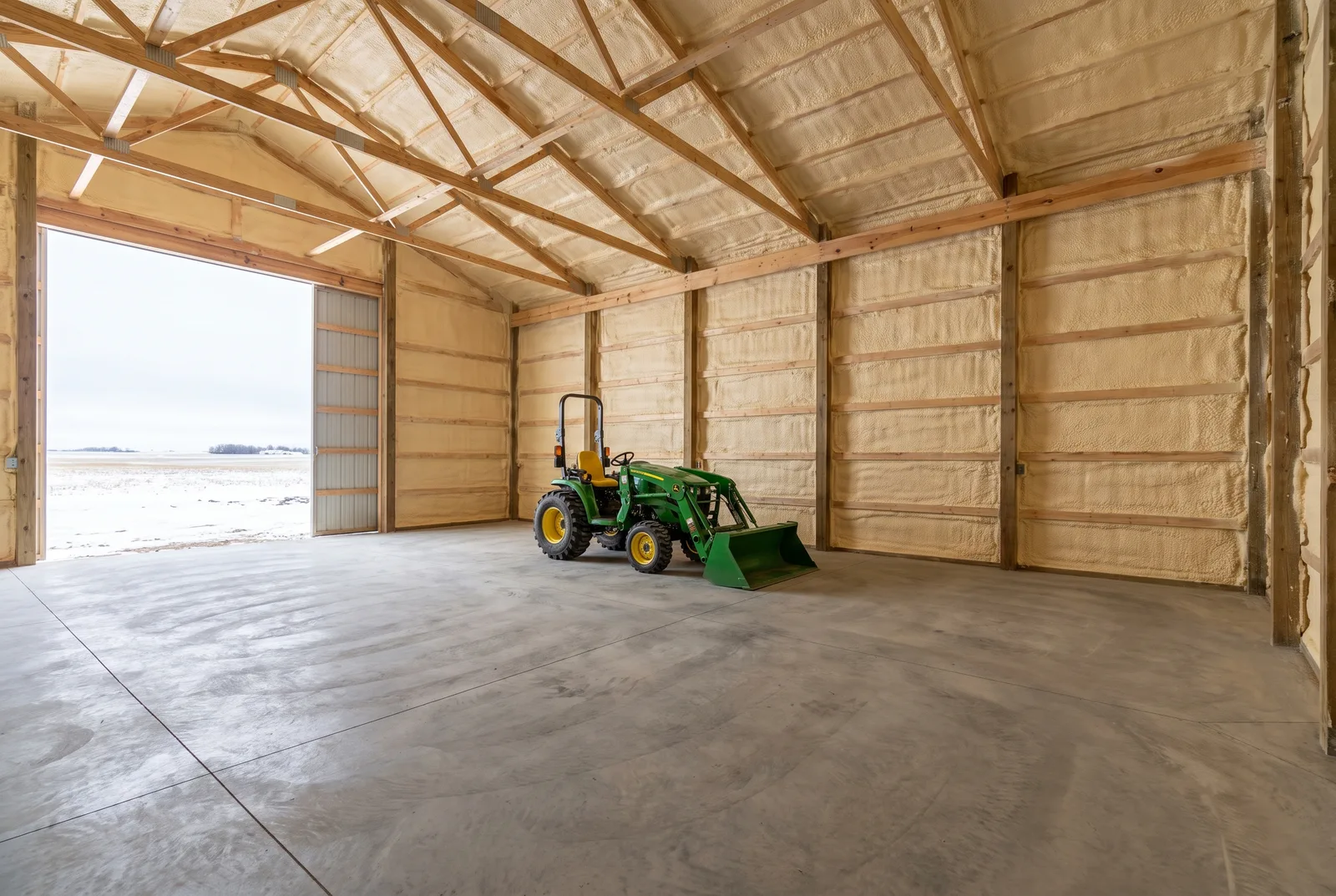
A heated shop gets full treatment: closed-cell on the roof deck and on the walls, with attention to the bottom of the wall where the steel meets the concrete or the skirt board. That bottom edge is the biggest air leak in most post-frame buildings. We also foam around the overhead door frames, the header, and any wall penetrations. Two to three inches on walls and two to three inches on the roof is a common spec. If you want more R on the roof, we can go thicker in lifts, or combine foam with a batt or blanket layer inside the purlins.
An unheated barn used for storage is a different calculation. Foam on the roof only, at a thinner thickness, stops the drip and keeps the building from frosting inside. Walls can be left bare. This is a common choice for equipment sheds and hay storage, and it costs much less than a full envelope.
An unheated barn with good ridge and eave ventilation and no moisture sources sometimes does not need foam at all. We will tell you that on the site visit.
Ridge and eave ventilation after foam
Most pole barns are built with a vented ridge and vented eaves so air moves under the roof steel and carries moisture out. Once closed-cell foam is sprayed to the underside of the roof, that ventilation path is no longer doing anything useful, because the steel is now isolated from the interior. In a full-envelope spray, we seal the eave and ridge openings as part of the job so wind does not blow into the foam edge.
If the building keeps a vented attic space above a ceiling, the approach is different. We insulate the ceiling instead of the roof deck, keep the ridge and eave vents open, and the attic stays cold and dry the way a house attic does. This works well in shops with a flat ceiling and a truss attic, and it opens the door to blown-in on the ceiling instead of foam on the roof. Which way we go depends on whether you want the space above the ceiling for storage or heat, and we talk that through before quoting.
Ag buildings and livestock
Barns with animals in them carry a heavy moisture load, and the foam choice matters. Closed-cell on the roof and upper walls stops the condensation and holds up to washdown. Open-cell is not a good fit in a livestock building because it absorbs water and does not act as a vapor retarder.
Lower walls in a livestock or calving barn often take abuse from animals and equipment. Foam sprayed at animal height needs a protective covering, either plywood, steel liner panel, or a sprayed coating. We plan that into the job so the foam lasts. Ventilation in an animal building still has to be designed for the animals, and foam does not replace that. It makes the building easier to heat and dry while the fans do their job.
What you get
- Ends the condensation drip off roof steel and purlins
- Turns a cold post-frame building into one that holds heat on a small furnace
- Seals the bottom-of-wall gap, fastener holes, and panel laps in the same pass
- No vinyl-faced blanket to sag, tear, or trap water
- Stiffens the steel skin and cuts wind noise in the building
- Owner quotes and sprays the job personally
How the job runs
- 1
Walk the building
We check the roof and wall steel, the purlin and girt spacing, the bottom-of-wall detail, ventilation, and whether the building is or will be heated.
- 2
Scope by surface
The quote names roof versus walls, the thickness on each, any ceiling or attic alternative, and any covering needed at animal or equipment height.
- 3
Mask and spray
Floors, doors, lights, and equipment get masked. We spray closed-cell in lifts direct to the steel and check depth as we go.
- 4
Seal vents, trim, clean up
Eave and ridge openings are closed where the roof deck was foamed, overspray is trimmed, and the building is swept before we hand it back.
What drives the cost of pole barn spray foam
Post-frame buildings vary more than houses, so the quote follows the building. These are the factors that move the number. Send a quote request with the building size, whether it is heated, and a few photos of the roof underside, and we will come out and measure.
- Roof and wall square footage, which is mostly set by building size and eave height
- Roof only versus full envelope
- Thickness in inches on each surface
- Lift height: a 14-foot eave sprays from a ladder, a 20-foot ridge needs a lift
- Removal of existing blanket or batts
- Whether the building is heated during the spray, which matters in winter
- Coatings or coverings where foam will stay exposed or at animal height
Common questions
How thick should spray foam be in a pole barn?
Two inches of closed-cell is the practical minimum on the roof, because that thickness stops condensation and acts as a vapor retarder. Heated shops usually get two to three inches on walls and roof. Unheated storage buildings can get a thinner roof-only spray to stop the drip. Thicker lifts are available where you want more R-value.
Do I need to remove the fiberglass blanket first?
Yes. Vinyl-faced blanket has to come down before foam goes on the steel. Foam needs a clean, dry surface to bond, and blanket left behind holds moisture between the foam and the metal. We take it down, bag it, and haul it as part of the job when it applies.
Will spray foam stop my pole barn roof from dripping?
Yes, when it is sprayed direct to the steel at two inches or more. The foam keeps interior air off the cold metal, so there is no surface for moisture to condense on. This is the single most common reason people call us about a post-frame shop, and it is the problem foam solves best.
Can I leave the ridge vent open after foaming the roof?
If the roof deck is foamed, the ridge and eave vents no longer serve a purpose and we seal them so wind does not drive into the foam edge. If you keep a cold attic above an insulated ceiling instead, the vents stay open and keep that attic dry. The site visit settles which approach fits.
Does foam need a covering in a shop?
It depends on the use. Exposed foam in a shop often needs an approved ignition barrier coating, and foam at animal or equipment height needs physical protection such as liner panel or plywood. We tell you what applies to your building and include it in the scope.
Where we do this work
We run pole barns & shops jobs out of our shop on the west side of Williston, and across the region: Williston, ND, Tioga, ND, Sidney, MT and everything within about an hour of the shop.
Related services
Get a quote on pole barns & shops
Send the basics and an owner comes back with a straight answer on what it needs, what it doesn't, and what it costs.